For many horse owners, the words “Horse Ration Balancer” immediately bring to mind a bag of pelleted feed. Maybe it’s a small pellet. Maybe it’s a larger pellet. Maybe it’s something you scoop by the pound and add to your horse’s hay. And because that is how ration balancers have traditionally been marketed, it’s easy to assume that a ration balancer has to be a pelleted feed.
But there is an important distinction that gets overlooked:
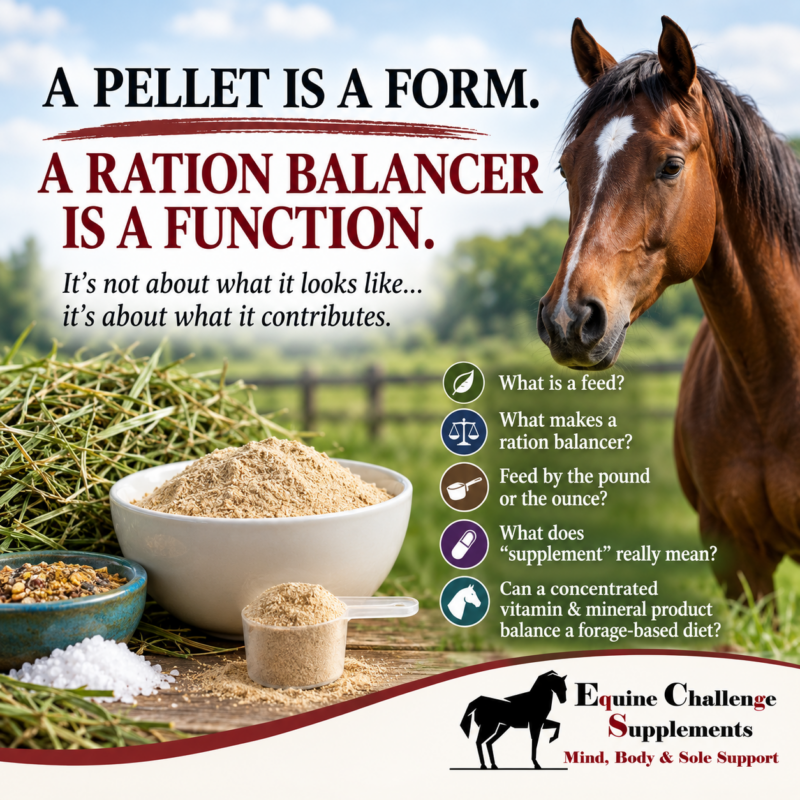
A pellet is a form. A ration balancer is a function.
What makes something a ration balancer is not whether it comes in a pellet, powder, meal, or another physical form.
It is what that product is formulated to contribute to the horse’s overall ration.
Once you understand that distinction, the relationship between feed, ration balancers, and supplements becomes much easier to understand.
When horse owners hear the word feed, they often picture a bag of commercial horse feed.
But “feed” is a much broader term.
In animal nutrition, feed refers to materials provided to an animal as part of its diet. That can include forage, grains, commercial feeds, ingredients, and other nutritional products.
In fact, AAFCO defines “balanced” in terms of whether a diet, ration, or feed provides known required nutrients in appropriate amounts and proportions for a particular animal and physiological purpose. The definition does not say that the product must be pelleted.
That is an important point.
Physical form does not determine nutritional purpose.
A horse can consume nutrients from:
The form is simply how the nutrients are delivered.
Before we can understand a ration balancer, we need to understand the word ration.
Your horse’s ration is essentially the total diet your horse receives over the course of the day.
That could include:
In other words, your horse doesn’t have just one “feed.”
Your horse has a total ration made up of everything being consumed.
And that is where the concept of balancing comes in.
A ration balancer is designed to provide nutrients that may be missing, insufficient, or out of balance in the rest of the horse’s diet.
Ration balancers are commonly concentrated sources of vitamins, minerals, and sometimes protein, while generally being relatively low in calories compared with traditional concentrate feeds. Veterinary references describe them as particularly useful for horses consuming forage-based or low-concentrate diets.
University of Minnesota Extension explains that ration balancers can provide vitamins and trace minerals that many forages don’t supply in sufficient amounts and can be fed in relatively small quantities because of their nutrient concentration.
The goal isn’t necessarily to add a lot of calories.
The goal is to help supply nutrients the overall ration needs.
And that brings us to a very important question.
No.
This is probably the biggest misconception we need to clear up.
A ration balancer does not become a ration balancer because it was pressed into a pellet.
And a product does not stop being capable of balancing a ration because it is in powder or meal form.
What matters is:
Those questions tell you far more about a product’s nutritional role than its appearance.
A pellet is simply a delivery form.
This is where some of the confusion comes from.
Many commercial ration balancers are designed to be fed at a specific daily amount, often measured in pounds.
For example, a product might have feeding directions calling for a certain number of pounds per day based on the horse’s body weight and workload.
That feeding rate is important because the manufacturer has formulated the product to deliver its intended nutrient contribution at that amount.
Merck Veterinary Manual notes that ration balancers generally have relatively low feeding rates compared with traditional concentrate feeds, although the exact amount depends on the product and horse.
But here’s the important part:
The fact that one product is fed by the pound doesn’t mean every product serving the same nutritional purpose must also be fed by the pound.
Think about it this way.
If you had two products sitting side by side:
Product A:
Fed at 1.5 pounds per day
Product B:
Fed at 2 ounces per day
It would be a mistake to assume Product A is automatically “better” simply because you’re feeding more of it.
Why?
Because weight does not tell you nutrient concentration.
One product may contain a relatively small concentration of nutrients and therefore require a larger feeding rate.
Another may be highly concentrated and provide its intended nutrients in a much smaller amount.
That’s why comparing products based solely on:
“How big is the scoop?”
or
“How many pounds do I feed?”
can be misleading.
You need to look at what is actually being delivered.
This is one of the areas where horse owners can easily get confused.
Traditional commercial feeds may provide:
And because they are providing a larger portion of the horse’s daily diet, they are often fed in relatively substantial quantities.
A concentrated vitamin and mineral product may have a completely different job.
It may be designed to provide a specific group of nutrients in a much smaller amount.
That means you might see one product fed in pounds and another fed in ounces.
Neither feeding rate tells you by itself whether one product is more valuable.
The feeding rate reflects the formulation and concentration.
This is another term that gets used very broadly.
In everyday horse nutrition conversations, a supplement generally refers to a product added to the existing diet to provide additional nutrients or nutritional support.
That might include products designed to provide:
But here’s where terminology gets important:
Not every supplement is designed to balance the entire nutritional ration.
A targeted supplement may be designed to address one particular nutritional goal.
For example, a product formulated specifically to provide additional hoof-support nutrients is doing something different from a product designed to provide the broad spectrum of vitamins and minerals needed to complement a forage-based diet.
Both can be called “supplements.”
But they don’t necessarily serve the same purpose.
Think about supplements in two broad categories.
A product designed to provide a broad range of vitamins and minerals that may be lacking in the horse’s forage-based diet can potentially serve a ration-balancing role.
Its job is to help fill nutritional gaps in the overall ration.
A targeted supplement is generally designed around a particular nutritional goal.
Examples might include products formulated for:
The goal isn’t necessarily to balance the entire diet.
It is to add something specific.
That’s an important distinction.
If we judge a product based only on what it looks like, we’re making a nutritional decision based on appearance.
And nutrition doesn’t work that way.
Pelleted isn’t automatically a ration balancer.
Powdered isn’t automatically “just a supplement.”
Bagged feed isn’t automatically nutritionally complete.
And a small scoop doesn’t automatically mean a product isn’t important.
Instead, ask:
Look at the guaranteed analysis and ingredient list.
Look at the manufacturer’s feeding directions.
Is it providing calories?
Protein?
Vitamins and minerals?
A specific nutrient?
Or a combination?
This is especially important when feeding forage-based diets.
Grass hay, alfalfa, oat hay and other forages don’t all provide identical nutritional profiles.
The goal should be to balance the entire ration—not simply choose a product because it looks familiar.
Forage is the foundation of most horse diets.
But forage is not nutritionally identical from one field, cutting, region, or hay type to another.
Grass hay and alfalfa, for example, can differ substantially in protein, calcium, and other nutrients. Merck Veterinary Manual notes that legume forages such as alfalfa generally provide more protein, minerals, and vitamins than grass hays.
That means the nutritional needs of a horse eating primarily grass hay may not be identical to those of a horse eating primarily alfalfa.
This is why forage matters so much when choosing a vitamin and mineral product.
University of Minnesota Extension specifically recommends considering the type of hay being fed when selecting a ration balancer.
The question shouldn’t simply be:
“What ration balancer should I buy?”
A better question is:
“What nutrients does my horse’s current ration provide—and what may be missing?”
That’s where good nutrition starts.
Here’s a simple way to think about the difference:
Primary purpose
Typical focus
Relationship to forage
Calories
Feeding rate
Physical form
Must be pelleted?
Main consideration
Help fill broad nutritional gaps
Vitamins, minerals and sometimes protein
Usually selected specifically to complement forage
Often relatively low
Depends on concentration
Can vary
No
Overall ration
Address a specific nutritional goal
Specific nutrients or nutritional support
May or may not be forage-specific
Varies by product
Depends on formulation
Can vary
No
Specific nutritional objective
The physical form is the least important part of this comparison.
Purpose and nutrient contribution matter more.
One of the easiest mistakes to make when comparing supplements is comparing the size of the scoop.
A scoop is a measurement of volume.
Nutrition is about nutrient delivery.
Two scoops of two different products could weigh completely different amounts.
And two products fed at completely different weights could potentially provide similar amounts of a particular nutrient.
That’s why you should follow the manufacturer’s recommended feeding rate and evaluate the nutrients being supplied at that rate.
Don’t compare supplements by scoop size. Compare what the horse actually receives.
Feeding rate: 1.5 pounds per day
1.5 pounds equals 24 ounces.
Feeding rate: 2 ounces per day
It would be easy to look at those two products and think:
“Product A must be providing much more.”
But that’s not necessarily true.
Product B may simply be more concentrated.
This is why the guaranteed analysis, nutrient levels, ingredients, feeding directions, and purpose of the product all matter.
The number on the scoop doesn’t tell the whole story.
It can—when it is formulated and intended to provide the nutrients needed to complement and balance the rest of the ration.
This is an important distinction.
We’re not saying that every product labeled “vitamin and mineral supplement” automatically qualifies as a ration balancer.
We’re saying that physical form and the word “supplement” do not prevent a product from serving a ration-balancing function.
If a concentrated vitamin and mineral product is specifically formulated to supply nutrients that may be missing from a forage-based diet (alfalfa, grass, oat, wheat, etc…), and its feeding directions are designed around that purpose, it can function as part of the nutritional foundation of the horse’s ration.
That is exactly why looking beyond the pellet matters.
Ration balancers are also not the same thing as a complete feed.
Complete feeds are formulated to provide the nutritional needs of the animal when fed as the sole ration, with the appropriate exceptions such as water. AAFCO’s feed terminology distinguishes complete feeds from other feed categories.
A ration balancer generally has a different purpose.
It is meant to be fed along with forage and/or other parts of the ration.
For most horses, forage remains the foundation of the diet.
The balancer is there to help supply nutrients that the rest of the ration may not provide adequately.
There’s another reason it’s important to look at the entire ration.
If you’re feeding a commercial feed, ration balancer, vitamin and mineral supplement, and several targeted supplements, nutrients can overlap.
This is especially important with certain trace minerals.
For example, selenium has a relatively narrow safety margin compared with many other nutrients. Merck Veterinary Manual emphasizes that total mineral intake from forage, concentrates, supplements, and even water should be considered when evaluating a horse’s mineral intake.
More isn’t automatically better.
The goal is balance.
That’s why it’s important to evaluate everything going into the feed tub—not just one product at a time.
This may be the biggest takeaway from this entire discussion:
You cannot determine the nutritional role of a product by looking at it.
Pellets are a physical form.
Powder is a physical form.
Meal is a physical form.
A bag is packaging.
None of those things tell you what the product is designed to accomplish.
Instead, look at:
The rest of the horse’s ration
That’s how you determine what role a product actually plays.
No.
A ration balancer does not have to be pelleted.
It does not have to come in a particular type of bag.
And it does not have to look like the ration balancers you’ve seen in the feed store for years.
What matters is what the product contributes to the horse’s overall nutritional ration.
A properly formulated concentrated vitamin and mineral product can serve a ration-balancing role when it is designed and fed for that purpose.
And that distinction is especially important for horse owners who feed primarily hay and forage rather than large amounts of commercial concentrate feed.
If you’ve always thought:
“Ration balancer = pellets.”
it’s time to rethink that equation.
The better way to look at it is:
Pellet = physical form.
Ration balancer = nutritional function.
The right question isn’t:
“Does this look like a ration balancer?”
The better questions are:
Because when it comes to equine nutrition, what is inside the product matters much more than what the product looks like.
And that’s an important distinction for anyone trying to make informed decisions about their horse’s nutrition.
No. A ration balancer is defined by its nutritional purpose & nutrient contribution—not by its physical form.
No. Pelleted products can serve many different purposes. Some are complete feeds, some are concentrates, some are forage products, and some are ration balancers.
Yes. What matters is its formulation, intended purpose, nutrient contribution, and feeding directions.
Generally, a ration-balancing product is intended to help provide nutrients needed to complement the overall ration, while a targeted supplement is intended to provide specific nutritional support.
No. A complete feed is formulated to provide the nutritional needs when fed as the sole ration, while a ration balancer is intended to complement other parts of the diet.
Start with the whole ration.
Look at the forage being fed, the amount of forage, any commercial feeds, and all supplements currently being provided. Then identify what nutrients are already being supplied and what may be missing.
You may also want to read:
The more we learn about equine nutrition, the more important it becomes to stop looking at horse feed through a one-size-fits-all lens.
Every horse’s ration starts with what that horse is actually eating.
Forage matters.
Nutrient levels matter.
Feeding rate matters.
And the purpose of every product added to the ration matters.
Don’t let the shape of a product make the nutritional decision for you.
Look inside the bag—not just at the form it’s in.
Share With Your Friends!