


If you have a horse that is an easy keeper, overweight, insulin resistant, prone to laminitis, or diagnosed with Equine Metabolic Syndrome (EMS), you have probably heard the term NSC in horse supplements being used.
Perhaps more importantly, how much does the NSC content of a horse supplement actually matter?
NSC stands for nonstructural carbohydrates. In simple terms, NSC refers primarily to the sugars and starches found in a horse’s diet. These carbohydrates provide energy, but some horses are particularly sensitive to diets containing higher levels of sugar and starch.
Understanding NSC can help horse owners make better decisions about hay, pasture, grain, ration balancers, and supplements—especially when managing a horse with metabolic concerns.
The important thing to remember is that NSC should be considered as part of the horse’s entire diet rather than looking at one feed or supplement in isolation.

When discussing horse nutrition, NSC is commonly estimated by adding water-soluble carbohydrates (WSC) and starch.
WSC includes simple sugars and other water-soluble carbohydrates, while starch is another form of carbohydrate that can be digested in the horse’s small intestine.
Forage laboratories may report WSC, ethanol-soluble carbohydrates (ESC), starch, and calculated NSC separately. This is one reason it is important to understand exactly what a forage or feed analysis is measuring.
According to University of Minnesota Extension, NSC is commonly estimated as:
NSC = WSC + starch
NSC levels can be particularly useful when selecting forage for horses that are sensitive to dietary sugar and starch, including horses with conditions such as insulin resistance, EMS, laminitis, or certain forms of PSSM.
Carbohydrates are not automatically bad for horses.
In fact, horses need carbohydrates. Fiber from forage is a major source of energy, and carbohydrates are an important part of normal equine nutrition.
The concern is that some horses do not handle large amounts of rapidly available carbohydrates as well as others.
When a horse consumes a diet containing significant amounts of sugar and starch, blood glucose and insulin responses can increase. For horses with metabolic disorders or insulin dysregulation, managing dietary carbohydrate intake can be an important part of their overall nutritional program.
Excessive starch intake can also have consequences for digestive health. When large amounts of starch escape digestion in the small intestine and reach the hindgut, changes in the hindgut environment can occur.
This is why simply asking whether a feed or supplement is “low sugar” isn’t always enough.
The better question is:
How much sugar and starch is my horse consuming from the entire diet?

This is one of the most important points for horse owners to understand.
For many horses, forage represents the largest portion of the daily diet.
A horse may consume many pounds of hay and/or pasture each day while eating only a small amount of a concentrated vitamin and mineral supplement.
That means the NSC contribution of a supplement needs to be considered in proportion to its feeding rate.
For example, a supplement that is fed at one or two ounces per day may contribute a very different amount of sugar and starch to the total diet than several pounds of a grain-based concentrate.
This is why evaluating only the percentage printed on a supplement label can sometimes be misleading without considering the actual daily feeding rate.
If you are managing a horse with metabolic concerns, testing the forage is one of the most useful steps you can take.
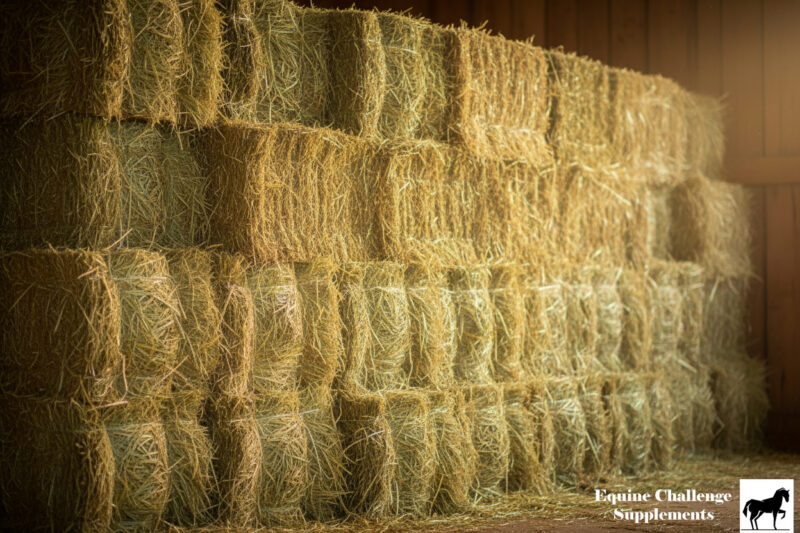
You cannot reliably determine the NSC content of hay simply by looking at it.
Grass species, maturity, growing conditions, weather, time of day, season, and other factors can all influence carbohydrate levels.
University of Minnesota Extension notes that cool-season grasses can have higher NSC concentrations and that forage carbohydrate levels can vary considerably. Testing a representative forage sample provides much more useful information than trying to judge carbohydrate content by appearance alone.
This is especially important because even hay that looks completely ordinary can have a carbohydrate level that is inappropriate for a particular metabolically sensitive horse.
There is no single NSC percentage that is appropriate for every horse.
However, nutritional guidelines commonly recommend keeping the overall diet at approximately 10–12% NSC or lower for horses with conditions such as EMS, laminitis, obesity, PSSM, or PPID, depending on the individual horse and veterinary or nutritionist recommendations.
It is important to understand that this is a guideline for the diet as a whole, not a universal rule that every individual supplement must meet.
Your veterinarian or equine nutritionist can help determine an appropriate carbohydrate level for your individual horse.
This is where things can get confusing.
A supplement can contain ingredients that contribute some naturally occurring carbohydrates while still contributing a relatively small amount of NSC to the horse’s total daily intake because the supplement is fed in a very small quantity.
For example, a concentrated supplement fed at one ounce per day contributes much less total carbohydrate than a feed that is fed at several pounds per day—even if the percentage of carbohydrates looks higher on paper.
That doesn’t mean the NSC percentage is unimportant.
It means percentage and feeding rate must be considered together.
A useful way to think about it is:
NSC percentage × amount fed = actual NSC consumed from that product
This is one reason horse owners should look beyond a single percentage when evaluating a supplement.
When choosing a supplement for a horse with metabolic concerns, consider several factors.
How much of the product does your horse actually receive each day?
A concentrated vitamin and mineral supplement fed in a small amount may contribute very little carbohydrate to the total diet.
Look at:
The goal is to evaluate the complete feeding program rather than focusing on one ingredient.
A horse receiving grass hay does not necessarily have the same mineral requirements as a horse consuming a predominantly alfalfa diet.
Forage-specific supplementation can help address nutritional gaps while avoiding the unnecessary addition of ingredients your horse does not need.
Equine Challenge Supplements offers forage-specific vitamin and mineral formulas for grass and alfalfa diets, including options with no supplemental selenium for situations where additional selenium is not desired.
A horse with a history of laminitis, insulin resistance, EMS, PPID, obesity, or PSSM may require a much more carefully managed nutritional program than a metabolically healthy horse.
Always discuss significant dietary changes with your veterinarian or qualified equine nutrition professional.
Reducing sugar and starch does not mean eliminating essential nutrients.
A horse still needs appropriate levels of vitamins, minerals, amino acids, and other nutrients.
The goal is not simply to feed the lowest possible NSC diet.
The goal is to provide a balanced diet appropriate for the individual horse.
This is one of the most important distinctions to make.
Imagine a horse eating 20 pounds of hay per day but only one ounce of a concentrated supplement.
Even if the supplement has a measurable NSC percentage, the horse is consuming dramatically more total forage than supplement by weight.
Therefore, the forage’s carbohydrate content can have a much larger influence on total daily NSC intake.
This is why testing hay and managing pasture access can be much more important than simply searching for a supplement labeled “low NSC.”
Ration balancers can be particularly useful for horses that need vitamins, minerals, amino acids, and other nutrients without receiving large amounts of feed.
A properly selected ration balancer can help fill nutritional gaps while being fed at a relatively small daily amount.
For example, Equine Challenge’s forage-specific ration balancers are designed around different forage types, including grass and alfalfa diets.
The Mind, Body & Sole Grass formula is an all-in-one ration balancer designed for grass-fed horses, while the Alfalfa formula is designed for horses consuming predominantly alfalfa forage.
The right choice should always be based on the horse’s forage, nutritional requirements, and overall diet.
Hoof supplements are another area where NSC questions frequently arise.
Horse owners may see ingredients such as flaxseed or other nutrient sources and wonder whether a hoof supplement is appropriate for a horse with metabolic concerns.
Again, the feeding rate matters.
Equine Challenge Hoof Propel, for example, is fed at a concentrated one-ounce daily serving. The product’s current educational information lists an NSC level of less than 5% and emphasizes that the amount consumed should be evaluated in the context of the entire diet.
This is an important concept for horse owners researching hoof supplements for easy keepers or metabolically sensitive horses.
“Low NSC” does not mean “carbohydrate free.”
Horses require carbohydrates for normal nutrition, and forage provides important fiber and energy.
The objective for a metabolically sensitive horse is generally to manage the amount and type of carbohydrate consumed, not to eliminate carbohydrates altogether.
The horse’s diet must still provide adequate fiber, protein, vitamins, minerals, and energy.
In some circumstances, soaking hay can reduce water-soluble carbohydrate levels.
Research summarized by University of Minnesota Extension indicates that soaking certain hays for approximately 15–60 minutes can reduce carbohydrate content, although the effectiveness varies with the hay and soaking conditions.
Soaking is not automatically necessary for every horse.
It is best used as part of a nutritional plan when appropriate forage is not otherwise available.
If you soak hay, it should generally be fed promptly afterward to reduce the risk of spoilage and mold growth.
Pasture can be a significant source of NSC.
Grass does not have a constant sugar and starch content. Carbohydrate concentrations can change with plant maturity, weather, season, temperature, and other environmental factors.
This is particularly important for horses prone to metabolic problems.
Some warm-season grasses, such as teff, tend to have lower NSC concentrations than many cool-season grasses, although individual forage should still be evaluated rather than assuming a particular species is always low NSC.
NSC management may be particularly important when feeding horses with:
These horses may benefit from a carefully controlled diet containing appropriate amounts of sugar and starch.
However, NSC management is only one part of managing metabolic health.
Body condition, exercise, forage intake, pasture access, mineral nutrition, veterinary care, and the horse’s individual diagnosis all matter.
One of the most common mistakes is focusing on one number.
For example:
“My supplement is only 8% NSC, so my horse’s diet is low NSC.”
That conclusion may not be accurate.
If the horse is consuming large amounts of high-NSC hay or pasture, the supplement’s NSC percentage may be a relatively small part of the overall picture.
Conversely, a supplement with a higher carbohydrate percentage may contribute very little total carbohydrate when fed at a tiny daily serving.
Always look at the whole diet.
You can estimate the amount of NSC supplied by a supplement using a simple calculation:
Amount fed × NSC percentage = approximate NSC consumed
For example, if a product contains 10% NSC and you feed 2 ounces per day:
2 ounces × 10% = 0.2 ounces of NSC
This is very different from feeding several pounds of a feed containing the same NSC percentage.
This simple calculation demonstrates why feeding rate matters just as much as the percentage itself.
When choosing a supplement, ask these questions:
These questions are much more useful than simply asking whether a supplement is “low NSC.”
Managing NSC does not have to mean being afraid of every gram of carbohydrate.
Instead, it means understanding where carbohydrates come from and making informed decisions about the horse’s entire diet.
For a metabolically sensitive horse, a well-designed feeding program may include:
The goal is nutritional balance—not simply the lowest possible NSC number.
NSC is an important concept for horse owners, particularly those managing easy keepers and horses with metabolic concerns.
But NSC should never be viewed in isolation.
The percentage of NSC in a supplement matters, but so does the amount fed. More importantly, the NSC contribution from the supplement should be considered alongside the NSC coming from hay, pasture, grain, treats, and other feeds.
For many horses, forage will make up the majority of the daily diet, making forage testing and appropriate forage management essential parts of a low-NSC feeding program.
When selecting supplements, look beyond a single number. Consider the horse’s forage, nutritional requirements, feeding rate, body condition, metabolic history, and overall diet.
At Equine Challenge Supplements, our goal is to help horse owners understand the “why” behind equine nutrition so they can build a feeding program around the individual horse—not simply choose products based on a label.
Have questions about NSC, forage, or choosing the right supplement for your horse? We’re happy to help you evaluate your horse’s nutritional program.
NSC stands for nonstructural carbohydrates. In horse nutrition, NSC is commonly estimated by adding water-soluble carbohydrates (WSC) and starch.
For horses with metabolic concerns, nutritional guidelines commonly recommend an overall diet containing approximately 10–12% NSC or less.
No. Not every horse requires a low-NSC feeding program. Horses with metabolic concerns or a history of laminitis may require more careful carbohydrate management than metabolically healthy horses.
No. Low NSC does not mean carbohydrate-free. It means the product contains a relatively lower amount of nonstructural carbohydrates.
Often, yes. Because forage makes up such a large portion of most horses’ diets, the NSC content and amount of hay or pasture consumed can have a major influence on total daily carbohydrate intake.
Testing forage is strongly recommended when managing a horse that is sensitive to dietary sugar and starch. Looking at the hay cannot reliably tell you its NSC content.
Yes, soaking can reduce water-soluble carbohydrate levels in some hays. The amount of reduction depends on the hay and soaking conditions.
Both matter. The percentage tells you the concentration, while the feeding rate determines how much NSC the horse actually consumes from the product.
Understanding NSC In Hoof Supplements
Equine Insulin Resistance and Metabolic Health
All In One Ration Balancer For Grass-Fed Horses
Grass Forage-Specific Vitamin and Mineral Supplement – No Added Selenium
No-Selenium, No-Flax Grass Ration Balancer
Alfalfa-Specific Horse Vitamin and Mineral Supplement – No Added Selenium
Alfalfa Ration Balancer — No Added Selenium
Share With Your Friends!